

Wooden Geometric Montessori Shape & Fraction Puzzle
Turn a few minutes of home time into hands-on shape, color, and early fraction matching. This compact wooden puzzle set works well for 3–6 year olds who are ready for tabletop play beyond basic baby toys but not yet ready for worksheets.


Is This Wooden Puzzle a Good Fit for Ages 3–6?
This puzzle set works best for children roughly 3–6 years old who are ready to move beyond baby toys into preschool tabletop activities. The chunky blocks and 15×15 cm boards fit preschool hands that can grasp, rotate, and place pieces into recessed slots.
Each wooden block drops into a matching recessed slot, so children can see when something does not fit and try again. The board layout gives a clear visual cue: compare the outline, turn the piece, and place it again.
Because the set includes multiple loose wooden blocks, it is intended for children around 3 and older during tabletop play with an adult nearby. For mixed-age homes, store the pieces away from younger siblings and bring the puzzle out for short guided sessions.
The boards use painted wooden pieces and recessed matching spaces. The main value comes from visible shape, color, and fraction play rather than electronic features, lights, sounds, or printed worksheets.
- Best used for ages ~3–6 years with an adult nearby.
- Includes multiple loose wooden blocks for tabletop matching play.
- Painted wooden boards and pieces with recessed matching spaces.
- Store pieces together and remove any damaged or chipped pieces.
What Matching Activities Can Children Practice?
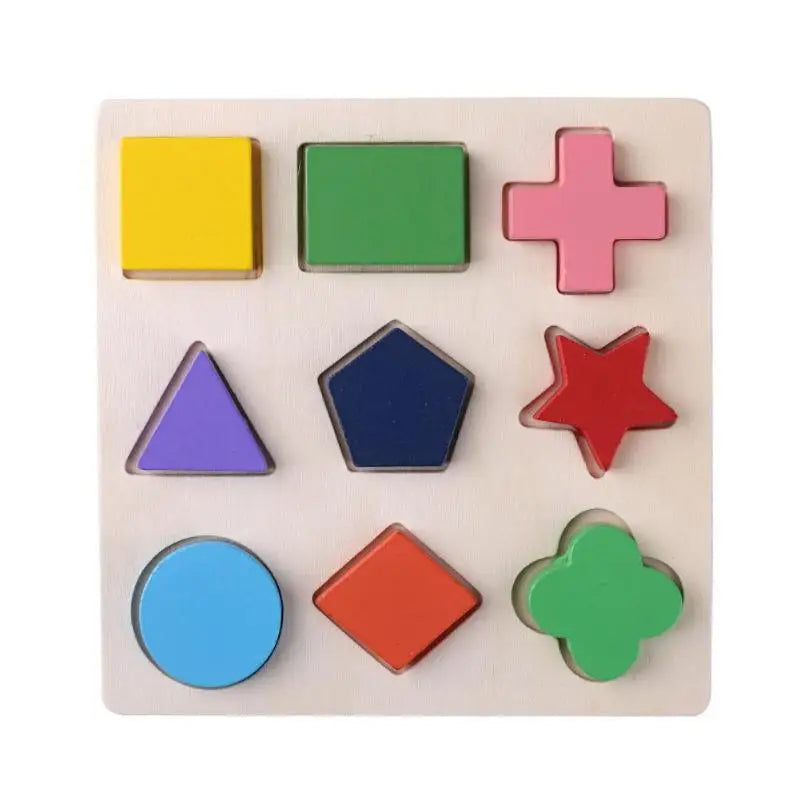
The basic shapes board uses circles, squares, triangles, stars, crosses, and more for repeated shape matching. Children look for the matching outline, turn the piece, and press it into the right slot.
Bright, contrasting colors across the blocks and boards create simple prompts for color naming and sorting. Parents can ask questions like “Can you find all the red pieces?” or “Where does the green star go?” during short play sessions.
The fraction-style boards split circles and rectangles into two or three colored parts. When children line up halves and thirds on the same base, they can see how smaller pieces combine to make one whole.
Because the blocks are thick and need a precise match to drop into place, each session uses clear hands-on actions: grasp, rotate, line up the edges, and place the piece without forcing it.
- Shape matching: circles, squares, triangles, stars, crosses.
- Color sorting: name and group bright, contrasting colors.
- Pick-and-place actions: grasp, rotate, align, and place chunky blocks.
- Early fractions: compare halves and thirds as parts of one whole.
- Short screen-free sessions: complete the board without lights, sounds, or apps.
How Does the Montessori-Inspired Design Go Beyond a Regular Puzzle?
Many products use the word Montessori loosely. Here, the core idea is simple: the boards are laid out so children can notice when something fits, notice when it does not, and try the piece again.
Each board focuses on a small number of ideas at once: basic shapes on one board, simple halves and thirds on the others. This keeps the task focused instead of mixing too many activities at the same time.
There are no lights, sounds, or screens built in. The interest comes from the child’s own actions—matching shapes, completing circles, and comparing how pieces fill the same space.
You do not need to follow a strict classroom method to use this design. Short, calm sessions with one board at a time can turn shape and fraction matching into an easy home routine.
- Self-correcting layout: children can see and fix mistakes.
- Isolated difficulty: shapes on one board, fractions on others.
- No built-in noises or lights so focus stays on the task.
- Made for short, repeatable, screen-free sessions at home.
How to Use the Puzzle at Home: Simple Play Ideas by Level
You do not need a formal lesson plan to use this puzzle as a tabletop activity. Short, predictable routines work best: bring out one board at a time, invite your child to explore, and add light prompts only when needed.
For younger preschoolers, focus on simple matching and naming. For older children, add challenges such as timed rebuilds, sorting by color, or building wholes from fraction pieces.
Because all three boards share the same 15×15 cm format, they stack neatly and can be rotated through the week. This keeps the activity familiar but fresh without adding more clutter to your shelf.
- Early stage (around 3 years): match one shape at a time and name it once it is placed.
- Middle stage (around 4 years): sort pieces by color or shape family, then complete the board.
- Later stage (5–6 years): use fraction boards to build one whole in as many ways as possible and compare which pieces are bigger or smaller.
Why Choose This Wooden Puzzle Over Apps, Flashcards, or Basic Jigsaws?
Preschoolers already see plenty of screens. This puzzle set gives them something different: solid wooden pieces to hold, a board that stays put on the table, and a clear goal they can complete without animations or sounds.
Compared with thin cardboard puzzles, the blocks here are thicker and easier for small hands to manipulate. When a piece drops into the recessed slot, the weight and feel give a clear cue that the match is correct.
Apps and worksheets can show shapes and fractions, but they do not provide the same physical actions: grasping, rotating, aligning, and pressing into place. For many children, that hands-on work keeps the activity concrete and easy to follow.
Because the boards are compact and reusable, they can live on a shelf and come out again whenever you want a quick, structured activity—without printing, charging, or updating anything.
- Screen-free: focus stays on hands and eyes, not notifications.
- Tactile feedback: real weight and texture, not just swipes.
- Durable boards: designed for repeated preschool use.
- Multi-skill: shapes, colors, early fractions in one set.
Frequently Asked Questions
What age is this wooden puzzle best for?
It works best for preschoolers roughly 3–6 years old who can grasp, place, and remove basic shapes during tabletop play. The set includes several separate blocks, so it is better for children who can follow simple matching prompts without treating the pieces as baby toys.
How can parents use this puzzle at home?
Start with one board and a small number of pieces. Invite your child to match the shapes, name each piece as it drops into place, then try simple prompts such as sorting by color or building one whole from fraction pieces.
What makes this more than just a basic shape puzzle?
Alongside the classic shape-matching board, you also get fraction-style boards that split circles and rectangles into two or three parts. That lets you move from naming shapes into simple part–whole games, such as building a whole from halves or comparing which pieces cover more of the same space.
How can I use this for tabletop practice if I’m not a teacher?
Start small. Invite your child to match shapes, then name each one as it drops into place. Later, sort pieces by color, count how many are left, or use the fraction boards to make one whole out of different parts. Short, calm sessions around 5–10 minutes are enough.
Will my child get bored with it quickly?
Most children can start with simple shape matching because the blocks are easy to hold and the goal is clear. Over time, you can add new challenges such as timed rebuilds, color sorting, or fraction games, so the same boards can be used in different ways.
Is this a good gift for a preschooler?
Yes, it works well as a practical gift for many 3–6 year olds. The familiar shapes and bright colors make it easy to start using right away, and the fraction boards add a next-step challenge as the child gets closer to kindergarten math activities.
Product Details & Specifications
| Property | Details |
|---|---|
| Product Name | Wooden Geometric Montessori Shape & Fraction Puzzle |
| Material | Painted wooden boards and blocks (exact wood type not specified in source listing) |
| Recommended Age | Approximately 3–6 years; includes multiple loose blocks and is not for children under 3 |
| Dimensions | Each board approx. 15 × 15 cm; individual block sizes not specified |
| Category – Age | 3–4 Years; 4–6 Years |
| Category – Material | Wooden Toys |
| Category – Skills | Hands-On Activities; Shape Matching; Color Sorting; Early Fractions |
| Use Note | Painted wooden puzzle with multiple loose blocks; intended for children around 3–6 years during tabletop use with an adult nearby; store away from children under 3 and remove damaged pieces. |