


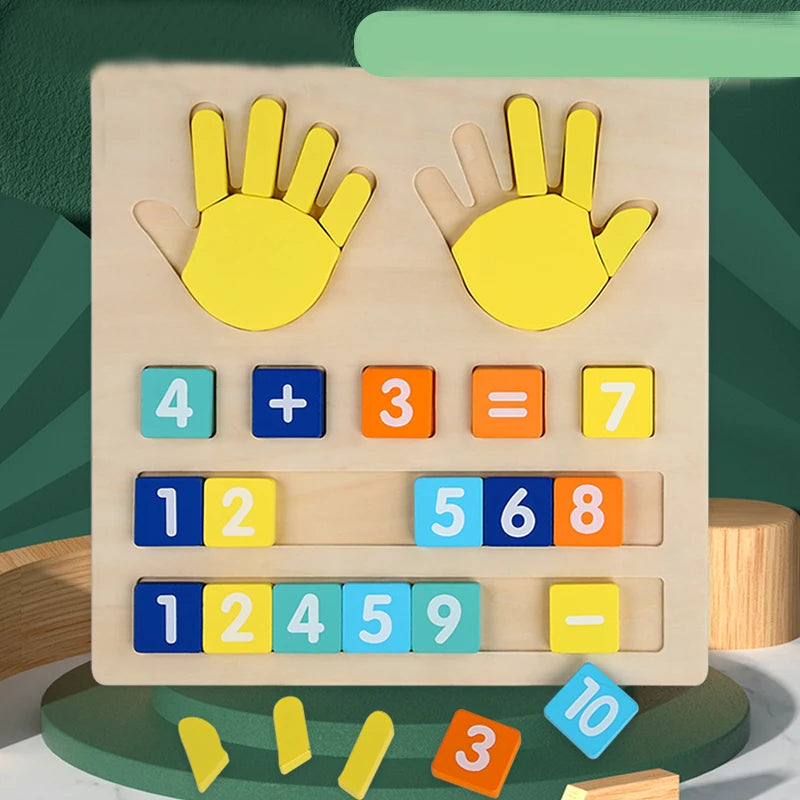
Montessori Wooden Finger Counting Math Board
Make early math easier to see and touch. This wooden finger counting board links finger patterns, dot rows, removable number blocks, and math cards in one tabletop layout for counting, number matching, addition, and subtraction play.


Age Fit & Use Guidance for Early Math Play
This wooden finger counting board is a good fit for children who are ready to move beyond saying numbers out loud and start matching numbers with visible quantities. It works best for preschool and early elementary learners who already recognize some numbers from 1–10 and are beginning to explore simple addition and subtraction.
Instead of lights or sound effects, the board uses a calm visual layout: finger outlines, dot patterns, removable number blocks, and math cards. Children can place, compare, swap, and count the pieces while an adult guides the activity with short prompts.
Because the set includes removable blocks and cards, it is best used as a tabletop activity with an adult nearby, especially for younger children. Store the pieces together after each session so the board is ready for the next round of counting or equation play.
- Best for children who recognize numbers 1–10 and are starting simple sums.
- Works well in short counting sessions rather than long drills.
- Includes removable number blocks and cards for guided tabletop play.
How the Finger Counting Board Turns Numbers Into Something You Can See
Many children first meet numbers as symbols on a page. This board connects three representations of the same number in one place: the finger pattern a child naturally uses to count, a row of dots that shows quantity, and a wooden number block that matches the symbol.
By sliding, matching, and swapping the pieces, children can compare what changes when they move from 3 to 5, or from 4 back to 2. The activity stays concrete because the child can see the number, touch the piece, and count the matching dots or fingers.
Finger counting is already a familiar way for many children to think through numbers. This board brings that strategy onto the table so adults can see how the child is matching, counting, and checking each quantity.
- Finger outlines show one visual way to represent each number.
- Dot patterns give a quick visual cue for “how many”.
- Number blocks connect the quantity to written numerals.
From Counting to Addition & Subtraction — Step-by-Step Play Ideas
You can use the same board across different early math activities. Start with simple one-to-one matching, then move into comparing numbers, and finally build simple equations using the number and symbol cards.
In the first stage, invite your child to match a number block to the correct finger pattern and dot row. Once this feels familiar, ask simple comparison questions such as “Which one has more?” or “What happens if we add one more block?” and let the child adjust the pieces.
When the child is ready, bring in the included math cards. Use them to set up simple equations like 2 + 3 or 5 − 1. Ask your child to show the problem on the board using fingers, dots, and number blocks, then read the equation together.
- Stage 1: Match numbers, fingers, and dots from 1–10.
- Stage 2: Compare quantities — more, less, and equal.
- Stage 3: Build basic addition and subtraction equations.
Materials & Care — Wooden, Reusable, Screen-Free
The board and blocks are wooden pieces with printed or marked number details. The tactile format gives children something physical to pick up, move, compare, and place without electronic noise or screen-based prompts.
For everyday care, wipe the surface with a dry or slightly damp cloth and allow it to air dry completely before storage. Avoid soaking the board or leaving it in very humid environments so the wooden pieces remain in good condition over time.
- Wooden board and removable number blocks.
- Screen-free format for focused tabletop math play.
- Wipe clean; avoid soaking or harsh cleaners.
Who This Board Is (and Is Not) For
This board fits families, homeschool corners, and classroom-style activity shelves that need a reusable tool for hands-on number matching. It works especially well if you already sit with your child for reading, puzzles, or short activity time and want to add a focused math block.
If you are looking for a toy that entertains a child completely on its own, this may not be the best match. The strongest use case is adult-guided tabletop play, where a parent or teacher can ask simple questions like “What do you notice?” or “Can you show that with blocks?” and let the child adjust the pieces.
- Good fit for parents and teachers who want guided, hands-on math play.
- Useful for homeschool math corners and Montessori-inspired shelves.
- Less suitable if you want a purely self-entertaining toy.
Common Questions
What age is this wooden finger counting board best for?
It works best for many children around 3–6 years old who can recognize some basic numbers, match simple shapes or symbols, and follow short tabletop prompts. Because the set includes removable blocks and cards, it is best used with an adult nearby and stored away between sessions.
Does my child need to know numbers before using this board?
It helps if your child can already recognize a few numbers, such as 1–5 or 1–10. You can start with matching games: place a number block, then find the finger pattern and dot row that belong with it. Over time, you can add comparisons and simple equation cards.
How can parents use this board for addition and subtraction play?
Use the blocks and cards to show what happens when pieces are added or removed. For example, place 2 blocks, add 3 more, then count the dots, fingers, or blocks together. The board gives children a concrete way to see and touch simple math changes during guided play.
How should I clean and store the wooden board?
Wipe the board and blocks with a dry or slightly damp cloth and let them air dry completely. Avoid soaking the wood or using harsh cleaners. Keep all blocks and cards together in a box or tray after each session so small pieces are not lost.
What does Montessori-inspired mean for this board?
It means the activity uses hands-on matching, clear visual order, and a simple tabletop layout. The board should be treated as a home or classroom-style math activity, not as a formal Montessori classroom material.
Product Details
| Property | Details |
|---|---|
| Product Name | Montessori Wooden Finger Counting Math Board |
| Material | Wooden board and removable blocks with printed or marked details; exact wood species and finish not confirmed in source listing. |
| Recommended Age | Approximately 3–6 years old; includes removable blocks and cards for adult-guided tabletop play. |
| Core Skills | Counting; Number Matching; Addition & Subtraction Play; Hands-On Activities. |
| Dimensions | Board and block dimensions to be confirmed; update once precise size and weight data from production are available. |
| Care Note | Keep removable blocks and cards together after each session. Wipe clean with a dry or slightly damp cloth; avoid soaking. |